Showing posts with label APEX. Show all posts

Friday, January 8, 2016

Coloring Cells in an Interactive Report

This is a quick post on something that came up on slack this week.
The task was basically to highlight certain cells in an interactive report based on the values in another column. While the highlighting feature in the interactive report is great that's one thing you can't do with it. You have the choice of highlighting the whole row or the cell in the column on which you based the condition. Another situation where the builtin highlighting isn't enough is when you need some complex conditions involving more than one column.

Took some iterations, but here's one solution to this.
I'll first outline the building blocks and then explain how they work together including some failed attempts on the way getting to this.
Interactive Report Query:
SELECT empno,
       ename,
       job,
       mgr,
       hiredate,
       sal,
       comm,
       deptno,
       CASE WHEN sal <= 1500 THEN 'data-style="background-color:green"' 
            WHEN sal > 1500 AND sal <= 3000 THEN 'data-style="background-color:orange"'
            WHEN sal > 3000 THEN 'data-style="background-color:red"'
            ELSE NULL
       END css_style
  FROM emp

Then set the css_style column to hidden and set the "HTML Expression" attribute on the column you want colored to something like the following.
Note: I use the SAL column here, but you can really use any column.
HTML Expression of column SAL:
<span #CSS_STYLE#>#SAL#</span>

The last bit is some JavaScript code which you put into a dynamic action firing on event "After Refresh" for the interactive report region. Make sure to also set "Fire On Page Load" to yes, otherwise you have no coloring after page load.
JavaScript Code:
apex.jQuery("span[data-style]").each(
  function()
  { 
    apex.jQuery(this).
      parent().attr( 'style'
                   , apex.jQuery(this).attr('data-style')
                   ); 
  }
);

If you don't want to read the full story you can stop reading here and have a look at the example app to be found at https://apex.oracle.com/pls/apex/f?p=83537.

Still reading?
Let's take a look at how we got to a working solution and how it does it's magic.

In the query we are laying the foundation by adding a column which computes the needed style for us. You might wonder why there is "data-style" instead of simply "style". Let me show you how the report would look if you would just be applying a style to the span element.
Just styling the span element

This doesn't look good and the reason is that the span element is an inline element only using the space it needs and not filling all available space as block elements do. Next try would be setting the span element to behave like a block element by adding display: block to the style definition.
Styling the span element with added display:block
A bit better, but this still isn't coloring the whole cell. To keep it short there where some other tries using some CSS-Wizardry which didn't work out too good either.
Back to the "data-style" thing. You are allowed to add your own custom attributes to HTML elements if you prefix them with "data-". Browsers will ignore them but from JavaScript or in this case jQuery you can access and utilize those attributes.
Let's have a closer look at the JavaScript code and walk through the logic.
  1. Select all span elements which have an attribute called data-style
    apex.jQuery("span[data-style]")
  2. Loop through the jQuery array and call an anonymous function for each item
    .each( function() {
  3. Find the current item's parent element (that's the for the cell)
    apex.jQuery(this).parent()
  4. Set the parent's style attribute using the span's data-style attribute
    .attr('style', apex.jQuery(this).attr('data-style'))
Finally we had something which looks very much like the inbuilt highlighting:


So long folks, this post actually got longer than I expected.

Happy IR-Hacking :-)

Wednesday, October 7, 2015

Using CodeMirror in your APEX Application

I just had a look at a blog post by Connor McDonald where he's asking for opinions how code should be presented on the AskTom website.
In my opinion I would love to have the line numbers removed from the actually code and instead let the get generated by a code highlighter.
With APEX 5 the development team uses CodeMirror for the App Builder, meaning the needed library is already included with every installation of APEX 5.

Getting your code highlighted

First of all I'm assuming you put your code into some sort of a tag, otherwise it wouldn't possible to distinguish code from other text. I did a quick check on the AskTom website and they seem to use the <pre> tag, so I'll use the same to demonstrate. Let's prepare a single page for displaying nice highlighted code.

Update page JavaScript and CSS attributes

Add following to JavaScript File URLs:
#IMAGE_PREFIX#libraries/codemirror/4.4/codemirror-custom.min.js
#IMAGE_PREFIX#libraries/codemirror/4.4/mode/sql/sql.min.js

Add this to the "Execute when Page Loads" sections:
apex.jQuery(".code").each(function() 
{ 
  var myThis = apex.jQuery(this);
  var myCode = myThis.html();
  var myMIME = myThis.attr("data-code-mode");
  myThis.empty();
  CodeMirror(
    this,
    {
      value: myCode,
      mode: myMIME,
      lineNumbers: !myThis.is('.nolinenumbers'),
      readOnly: true
    }  
  );      
});
This code searches all elements having class "code" and uses the contained html as the code to highlight. The language is derived from an attribute called "data-code-mode", if you want to use something else than what is included in the sql.min.js file you need to include additional files from  the CodeMirror mode directory.

In CSS File URLs add the CodeMirror gloabl css file:
#IMAGE_PREFIX#libraries/codemirror/4.4/codemirror-custom.min.css

Finally specify this for Inline CSS:
.CodeMirror {
    height: auto!important;   
}

Adding code blocks

Now just add a new region to the page, I have used static content for now as this is just an example.
The content of the region is the following:
This is some text first...
Now show code:
<pre class="code" data-code-mode="text/x-plsql">DECLARE
  l_data VARCHAR2(32767);
BEGIN
  NULL;
END;</pre>
More text below code block.
now using a div for code:
<div class="code" data-code-mode="text/x-plsql">
SELECT user
  FROM dual;</div>
Nice, isn't it?

Finally some code without line numbers 
<span class="code nolinenumbers" data-code-mode="text/x-plsql">SELECT * FROM emp;</span>
where we just select everything from the famous emp table.

And the rendered result looks like this:

This is all more or less a quick hack, but I hope you get the idea and can make some good use of it.

Tuesday, September 1, 2015

IR Column Headings with HTML in APEX 5

Old and new world

This might be something for all of you that have used HTML in interactive report column headings .
It was a convenient way to break up long headings if you already knew the content was much smaller.
To give you an example think of a date field with format mask 'DD.MM.YYYY' and a column heading of 'Final Auditor Approval Date'.
Now compare the size of the content to the heading size, which is 10 characters to 27 characters, so you might be wasting a lot of real estate for this column.
One approach is to specify the column width and enable word wrap using css, but what if you wanted the column heading to wrap at a specific position?
Well you can play around with your css rule until you get the desired result or you simply embed an html line break into your column heading and I typically used the latter.
The minute you upgrade to APEX 5 there's a small caveat with this solution.
Let me show you an example of what I'm talking about:

Do you see the html characters in the column list when you click on the magnifying glass?
In APEX versions before 5 the tag was replaced by a blank, nowadays it's escaped.
APEX 5 has gotten way better responsive features than before, but what if even that isn't sufficient?

There's an app plugin for that

Having the immediate need to find a solution I decided to create a plugin to solve this issue.
While thinking of options one that quickly came up was using the "Single Row View Label" as I'm not using the "Single Row View" in any of my applications.
Below you see an example I used during testing:
I removed the line break from the "Heading" and then changed the "Single Row View Label" to include it. So the data is stored in the APEX Metadata and I should now be able to use it.

The plugin itself is a dynamic action plugin and puts a small JavaScript function into the page.
The function retrieves a JSON object with column ids and column headings and then iterates over the object replacing the heading. Below you find sample code for the function:
function de_itt_apexir_hdr_break()
{ apex.server.plugin
  (
    '#AJAX_IDENT#' // This gets replaced by apex_plugin.get_ajax_identifier
  , { x01: this.affectedElements[0].id } // IR id
  , { success: function( pData ) 
               { apex.jQuery.each
                 ( pData, function(index, value)
                   { apex.jQuery("#" + index + " > a").html(value); }
                 ); 
               }
    }
  );
};

The callback function runs following query to compose the JSON object:
SELECT 'C' || aapic.column_id column_id
     , aapic.form_label
  FROM apex_application_page_ir_col aapic
     , apex_application_page_regions aapr
 WHERE aapic.region_id = aapr.region_id
   AND aapr.application_id = apex_application.g_flow_id
   AND ( aapr.region_id = to_number( regexp_substr( apex_application.g_x01, '\d+') )
      OR aapr.static_id = apex_application.g_x01
       )
   AND aapic.report_label != aapic.form_label
;

So far my tests didn't show any negative impact except for the obvious extra round trip to the database. Below screenshot shows same IR as before but using the plugin.


Want to test the plugin?  Download it here and install like any other plugin.
Follow the included readme file to create a dynamic action based on the plugin.
I haven't run that many tests yet, but maybe you would like to help?
If you encounter any issues or have recommendations, either open an issue in the repository or write a comment here.

Hopefully the plugin helps you to overcome one of the small hick-ups when upgrading to APEX 5.

Thursday, August 13, 2015

Using conditional compilation for APEX dependent code

I'm currently working on a new release of my PPTX Creator Package.
While adding parts which would only compile if APEX is installed in the database I thought maybe it's a bad idea to introduce a hard dependency as a lot of the code doesn't need APEX installed.
So I needed to come up with a way to allow installation without APEX, but also enable additional functions when APEX is installed.
The options I checked where:
  1. Split into APEX-specific and generic package
  2. Offer two versions of the package
  3. Use conditional compilation
From the titel you might already know which option I chose, but let's briefly look at the implications of the options.

Option 1:
Splitting into two packages seemed like an immediate win as it feels natural for the use case. However when looking a bit further it could lead to the need of exposing internal parts of the generic package.
Running on 12c you could use the ACCESSIBLE BY clause to mitigate, but not everyone is on 12c (yet). A good blog post on the ACCESSIBLE BY clause can be found here.

Option 2:
I immediately moved over that option, just imagine the maintenance effort:
It would be a like fixing two different packages with a lot of copy-and-paste code back and forth.
No I don't want that!

Option 3:
I decided to use conditional compilation for the APEX specific features. For those of you who don't know conditional compilation yet, have a look at this Oracle Magazine Article by Steven Feuerstein from 2006 and also check out the links in that article.
In short conditional compilation allows you to exclude or include parts of the package during compilation based on conditions specified. A typical use case for conditional compilation is having one package which conditionally compiles with different code based on the Oracle Release.

So I had decided to use conditional compilation, but then I realized that I hadn't thought of how to determine if APEX is installed. Unlike the version use case, for which the database provides the DBMS_DB_VERSION package, there is no such thing for verifying installed components.
So let's start with how to generally check if APEX is installed.
If you have DBA rights you can use following query:
SELECT comp_name, version, status
  FROM dba_registry
 WHERE comp_name = 'Oracle Application Express'
;

Without DBA rights it's a bit different, as there is no ALL_REGISTRY table in the dictionary. There is a USER_REGISTRY table but that doesn't help either.
However there is something called ALL_REGISTRY_BANNERS and we can use that one with any user. To check if APEX is installed simply run the following query:
SELECT banner
  FROM all_registry_banners
 WHERE banner LIKE 'Oracle Application Express%'
;

Now let's move on to finding a means to use the query result for controlling the conditional compilation. You can also use user-defined flags for controlling the compilation process, below show how to set a flag called apex_installed for your session.
ALTER SESSION SET plsql_ccflags = 'apex_installed:1';
You can reference this flag in conditional compilation blocks within your code.
To recap, we now have a means to check whether APEX is installed and we are able to set a flag to be used by the conditional compilation.
Putting everything together I ended up with an install script similar to the code code.
SET define '^'
define HASAPX = '0'
column apx new_val HASAPX

SELECT '1' AS apx
  FROM all_registry_banners
 WHERE banner LIKE 'Oracle Application Express'
   AND ROWNUM = 1
;

ALTER SESSION SET plsql_ccflags = 'apex_installed:^HASAPX';
@@install_package.sql

Within the package you surround the code blocks with something like
$IF $$apex_installed = 1 $THEN
-- Put APEX specific code here
$END
To catch the case when the flag isn't set before compilation include an error clause like below
  $IF $$apex_installed IS NULL $THEN
    $ERROR 'Set CCFLAG apex_installed to either 0 or 1.' $END
  $END

That's all for now folks, but stay tuned for the next release of my PPTX Creator package with much enhanced functionality.

Monday, February 23, 2015

APEX IR XLSX Downloader V1.3.0

After a long time I have finally published Release 1.3 of my APEX IR XLSX Downloader.
And because I kept you waiting so long there's one goody included.

Added Features

  • The Interactive Report region ID is now automatically derived if not specified or set NULL.
  • Function get_version which emits the package release you are running.

Bugs Fixed

  • Column header wasn't filled if user didn't give a custom name for a function column in "Group By" view.
    Now the package puts similar names to what the APEX engine generates.

New Demo Application

There is also a new demo application available for download.
You can download it here and install into your own APEX workspace.

As always the source code can be found in the GitHub Repository.
ZIP files for all my GitHub projects can now be found on my GitHub Page.

Enjoy ;-)

Saturday, January 31, 2015

Oracle Application Express EA3 is now available

APEX EA3 is here

Just read this one on Twitter:
So head over to apexea.oracle.com, request your workspace and start testing all the new features.

I received my access within minutes, so be prepared to immediately have a reason for spending time on your computer. ;-)
First thing I did was checking out the "Universal Theme Sample Application".
Shakeeb did a very good job of explaining the Universal Theme Components.

Interestingly the beta documentation for APEX 5.0 was already made available.
A very nice move in my opinion. Click on the link above or use http://docs.oracle.com/cd/E59726_01/index.htm.

So long for now folks and enjoy your first weekend with APEX 5.0 EA3. ;-)

Friday, January 30, 2015

APEX jQuery Modal Dialog Oddities

Lately I have been working on creating a new version of my demo application for the APEX IR XLSX Downloader.
The package provides a set of configuration parameters which I thought would be nice to present to the user instead of being solely defined by the developer.
During that I encountered some oddities when using a jQuery Modal Dialog to render a region as a modal dialog.

Note: I'll show you the steps to reproduce and fix in a newly created application. But you can also just create a new page in an existing application.

Steps to reproduce and fix:
  1. Navigate to the page where you want to put the modal region containing form elements.
  2. Create a new region accepting all defaults
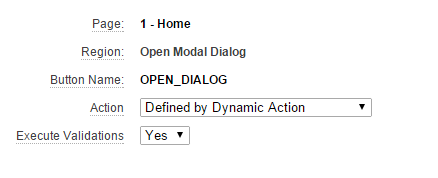
  3. Create a button in that region and set Action to "Defined by Dynamic Action"
  4. Create a new region accepting defaults except for "Display Attributes"
    Select "jQuery Modal Region Template" as "Region Template"
  5. Create at least one item which should save session state on the modal region.
    I used a text item and made it submit on enter for this example.
  6. Create the dynamic action reacting to button click.


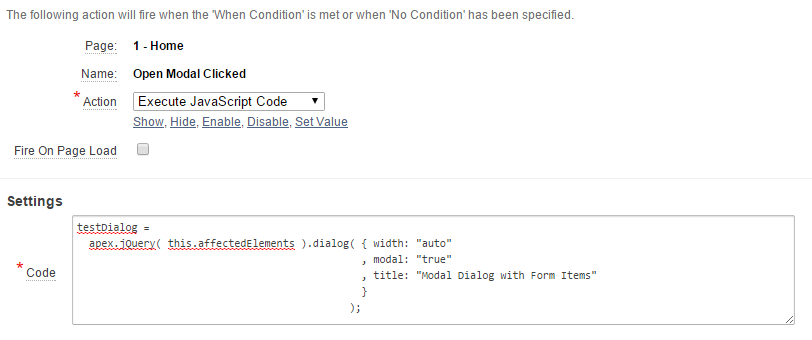
  7. Run a simple test
    1. Run the page
    2. Click open Dialog button
    3. Enter something in the text field and hit enter.
    4. Now verify session state
    5. So we submitted the page with a new value in the item, but it doesn't look like it was pushed into session state.
  8. Finding the reason for session state not being updated.
    1. Analyze DOM before dialog open.
    2. Analyze DOM after dialog open.
  9. This tells us that the region gets moved outside of the <form> container, making the item invisible to APEX.
    Therefore no update in session state.
  10. Steps to fix DOM
    1. Create Dynamic Action which fires "Before Page Submit"
    2. Set action to "Execute Javascript Code":
      apex.jQuery( this.affectedElements ).dialog( "destroy" ).appendTo( 'form#wwvFlowForm' );
      
    3. Set "Affected Elements" identical to previous Dynamic Action.
  11. Test again with same steps as noted in 7.
    This should now work.


  12. Enjoy nicely working modal dialogs.

Tuesday, December 9, 2014

APEX IR XLSX Downloader V1.2.3

I have just published Release 1.2.3 of my APEX IR XLX Downloader.

André Meier had a look at my package after DOAG 2014 and pointed out some hick-ups he encountered while using it.
He also made a big effort to bring some proper code formatting and explicit conversions into the XLSX_BUILDER_PKG which is one of the libraries used.

A huge thank you to André, as many of the changes are based on his contribution.

Changes

  • XLSX_BUILDER_PKG
    • Explicit Conversions
    • Code Formatting
    • Better CLOB building using VARCHAR2 buffer (as shown in a previous post)
  • APEXIR_XLSX_PKG
    • If splitting report_columns string would produce a NULL index this is now taken care of and a warning is send to the APEX debug messages.

As always the source code can be found in the GitHub Repository.
ZIP files for all my GitHub projects can now be found on my GitHub Page.

The new demo application is currently under development and will be published soon.
I'm currently creating some sort of packaged application which will better showcase all the different options available.

Stay tuned for more to come.

Tuesday, November 25, 2014

APEX_IR.GET_REPORT Limitations & Wishlist

Luckily nowadays we as APEX developers have access to APEX_IR.GET_REPORT which gives us back the current query of an interactive report.
With that we can actually build really nice plugins enhancing the functionality.
However one thing you have to be aware of is that it will always give you the query of the "Report" view, so if you want to get the query behind the "Group By" view it's back to rebuilding the query manually.
Talking to Patrick Wolf during DOAG 2014 he asked me to write a blog post about it and showcase the behavior.
Therefore I have created a small demo on apexea.oracle.com using an interactive report and a dynamic action to see if the same behavior is also still in APEX 5.
The dynamic action gets the IR query using APEX_IR.GET_REPORT and also sets a read-only field to SYSDATE in order to show it actually fires on event "After Refresh".
You can check out the current behavior here.

So here's my wishlist for the APEX development team:

  • Please give us the query also for the other view-types available for an interactive report.
  • And if you want to supercharge the function give us an additional parameter for choosing whether we want the query for the currently displayed view-type or a specific one.
I imagine a possible function declaration like below:

FUNCTION get_report( p_page_id      IN NUMBER
                   , p_region_id    IN NUMBER
                   , p_report_id    IN NUMBER DEFAULT NULL
                   , p_view_mode_in IN VARCHAR2 DEFAULT NULL
                   )
  RETURN t_report;

So if you do not specify the fourth parameter you get the query for currently displayed view mode, similar to the third already available parameter.

Wednesday, November 19, 2014

APEX IR XLSX Downloader V1.2.2

I have just published release 1.2.2 of my APEX IR XLX Downloader.
While attending the DOAG 2014 Conference Dietmar Aust was trying out my package and guess what...
He ran into a bug, so thanks Dietmar for reporting this.

Bugfix

  • Columns without help text break the download.
As always the source code can be found on GitHub.
ZIP files for all my GitHub projects can now be found on my GitHub Page.
For a small demo visit my Demo Application on apex.oracle.com.

Wednesday, November 12, 2014

APEX IR XLSX Downloader V1.2.1

Well, just three days ago I published release 1.2.0.
In the meantime I've been working on updating the README to give you all a better start.

This time there are no bugfixes included as it's only documentation.

Documentation Changes

  • Added list of features
  • Added current limitations
  • Updated "How to Use" section
As always the source code can be found on GitHub.
ZIP files for all my GitHub projects can now be found on my GitHub Page.
For a small demo visit my Demo Application on apex.oracle.com.

Sunday, November 9, 2014

APEX IR XLSX Downloader V1.2.0

I have just published a new minor release of my APEX IR XLSX Downloader.
This time I have fixed a bug regarding control breaks and added one enhancement to column headers.

Enhancement

  • Help text as defined on IR column is now added as a comment to the column header in the spreadsheet.

Bugfix

  • Control breaks with just number or date column are now working.
As always the source code can be found on GitHub.
ZIP file is available in my demo application.

Saturday, September 13, 2014

APEX IR XLSX Downloader V1.1.3

I have just published a new bugfix release of my APEX IR XLSX Downloader.
This time I had to fix some bugs regarding aggregations.

Bugfixes

  • Aggregation values are now always taken from the correct SQL columns.
  • Columns without aggregations defined no longer break the formatting on rows with aggregation values.
As always the source code can be found on GitHub.
ZIP file is available in my demo application.

Friday, September 5, 2014

APEX IR XLSX Downloader V1.1.2

Just a week ago I published a release which supports getting the  GROUP BY report from an IR.
Like most new functionality this one isn't bug free either.
Therefore I have just published release 1.1.2 of my APEX IR XLSX Downloader.

Bugfixes:

  • Package didn't recognize the special aggregate functions like COUNT_DISTINCT, RATIO_TO_REPORT_SUM and RATIO_TO_REPORT_COUNT.

Added Functionality:

  • Internal function to convert column display order into column identifier.
    This will support lifting the column restrictions on GROUP BY reports in the future.
Source code can be found on GitHub.
Download available in my demo application.

Enjoy. ;-)

Friday, August 29, 2014

APEX IR XLSX Downloader - New Release available

Release 1.1.1 of my APEX IR XLSX Downloader has just been published.

Bug Fixes:

  • Highlights now also support the operators "in" and "not in".
  • Highlights with no user defined name now properly display the highlight condition.
  • Still existing filters on removed columns no longer result in an exception, they are simply ignored now.
  • Columns used in link targets are now excluded if not visible on their own.

Added Functionality

  • Added a wrapper procedure handling the whole download task.
    Parameter list is the same as the function returning the results.
  • Initial support to receive the GROUP_BY report if defined.

Known Limitations

  • Standard and GROUP_BY report cannot be exported together into a single file.
  • Columns used in GROUP_BY also need to be present in the standard report, otherwise the columns are not included in the query generated by currently available APEX API.
You can look a the source code on GitHub.
ZIP Archive of package including dependencies can be downloaded from Demo Application.

Wednesday, August 27, 2014

APEX Dictionary - Who uses a column in filters?

I just had the requirement to find out if some users have filters defined on a certain column of an interactive report.
First try was looking at the saved reports view in the application builder, but that didn't help.
And again the APEX Dictionary Views to the rescue.
Following query can be used to check if a column is used in a column filter or highlight.

SELECT r.created_by
     , condition_type
     , cond.condition_name
     , condition_column_name
     , cond.condition_operator
     , cond.condition_expression
     , cond.condition_expression2
     , cond.condition_display
  FROM apex_application_page_ir_cond cond JOIN
       apex_application_page_ir_rpt r
         ON r.application_id = cond.application_id
        AND r.page_id = cond.page_id
        AND r.report_id = cond.report_id
 WHERE cond.application_id = :application_id
   AND cond.page_id = :page_id
   AND cond.condition_column_name = :column_name
;

Note: It will not find column usage in a row filter.

May the APEX Dictionary be with you!

Tuesday, August 12, 2014

APEX Dictionary - Comparing two Interactive Reports

Recently I again had the requirement to compare two Interactive Reports from different applications.
Using the power of the APEX Dictionary this can be done quite easily.

WITH prod AS
(
SELECT column_alias, application_id, report_label, help_text
  FROM apex_application_page_ir_col
 WHERE page_id = :page_id_prod
   AND application_id = :app_id_prod
), dev AS
(
SELECT column_alias, application_id, report_label, help_text
  FROM apex_application_page_ir_col
 WHERE page_id = :page_id_dev
   AND application_id = :app_id_dev
)
SELECT NVL(prod.column_alias, dev.column_alias) column_alias,
       prod.report_label prod_label,
       dev.report_label dev_label,
       CASE WHEN prod.column_alias IS NULL THEN 'Only DEV'
            WHEN dev.column_alias IS NULL THEN 'Only PROD'
            WHEN prod.report_label != dev.report_label 'Differs'
            ELSE NULL
       END status
  FROM prod FULL OUTER JOIN dev ON (prod.column_alias = dev.column_alias)
ORDER BY NVL(prod.column_alias, dev.column_alias)
;
I used "prod" and "dev" as identifiers for the different settings.
This time I was mainly looking for the report labels, but you can easily extend the query to include additional fields from the APEX_APPLICATION_PAGE_IR_COL view.

This has been in my stash for a while but I didn't publish it before.
Oliver Lemm just started a series of APEX Metadata related posts and made me think let's share this snippet.

May the APEX Dictionary be with you!

Thursday, August 7, 2014

DOAG 2014 Conference - Program announced

The conference program for DOAG 2014 is available.
It's even harder than last year to plan because there are so many interesting sessions running in parallel.

However one session was easy to choose
for one simple reason: I'm the presenter. ;-)

I think the time-slot Thursday 14:00 - 14:45 is also a pretty good one.
Means I have enough time to recover from the community event Wednesday evening...

See you all at DOAG 2014!
   Moritz

Monday, July 28, 2014

Speaking at DOAG 2014

For the first time I did apply to be a speaker at DOAG 2014.
Luckily my presentation has been selected so I get the honor to present at this amazing conference.
Are you interested in a brief overview what I will talk about?
Currently I have two APEX and OOXML (Open Office XML) projects which are finished or near to be finished.

APEX IR XLSX Download

The first project uses the really nice XLSX Builder Package created by Anton Scheffer which makes it easy to create Excel OOXML (XLSX) files using a SQL Query or PL/SQL calls.
I made some enhancements and build an additional package on top of it which takes the information from an Interactive Report and creates a spreadsheet representation of it.
Currently supported is only the "Report View" but there are plans to also support "Group By View" in a later release.

How to Use

The package has one main function which just needs the Region ID of the Interactive Report.
This function returns a record with the generated file and additional attributes you might need when offering the file for download.

You can get more information on GitHub where I store the source code.
ZIP Archive of package and dependencies can be downloaded from Demo Application.

PPTX Slide-Deck Generation

The second one is about creating PowerPoint slide-decks based on a template file.
I based my work on a package called OOXML_UTIL_PKG written by Morten Braten.
The package already allows to replace substitution patterns int XLSX, DOCX and PPTX files and many other things also, take a look at above link to learn more.
This time I didn't build a wrapper but used the ideas and build a package just to deal with PowerPoint files but enhancing the pattern replace to create multiple slides if more than one row of replacement strings is handed to the main function.

How to Use

You create your file with one slide using PowerPoint and replace the content you want dynamic with substitution strings. (e.g. #EMPNO#)
Afterwards you upload the template file as a BLOB into the database.
To generate the slide-deck just call the main function handing in the BLOB holding your template, a 1-dimensional array with your patterns and a two-dimensional array with the values replacing the patterns.

The source code is also stored on GitHub and ZIP archive available in Demo Application.


Can I see a demo?

If you haven't seen the hints above here it is again. :-)
Just head over to my Demo Application to see the packages in action and download ZIP archives for installation.

Demo Application Online

Finally my own demo application is online.
It will always be work-in-progress as I will be adding various features as they evolve.

At the moment it serves as a showcase for

  • Creating XLSX files from Interactive Report.
  • Generate PowerPoint slide-decks from a template slide.
  • Code-Highlighting using CodeMirror.
The demo application is hosted at apex.oracle.com, click here to open it.

My next post provides some details.